The Middle Finger Link to heading
I was recently at a Hackathon standing in a group of people introducing ourselves. At one point someone I hadn’t met before ask me how I knew someone else in our group. I said “Oh we know each other from NashFP”. “What’s NashFP”, he asked. “Nashville Functional Programming group”. He asked us what functional programming was and after a few attempts at describing functional programming he finally asked us “What’s a functional programming language I might recognize?” We listed a few and then one of us said “Lisp”. At that moment he interjected “Oh Lisp! I know enough about Lisp to give it the middle finger!” Soon after he exited the conversation.
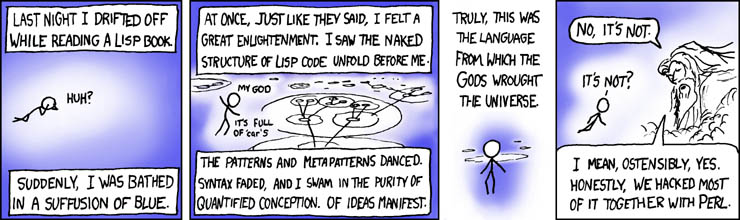
The encounter encouraged me to write a blog post to explain a couple of things that tripped me up at first. To do this I’m going to be using Clojure for examples, mostly because it’s a modern Lisp and it seems to be growing in popularity… That and I just love Clojure.
How Do I Even Lisp? Link to heading
The first time you see a snippet of Lisp it can be pretty confusing. You’re probably used to being able to type 2 + 2 and get 4. If you’re use to that than Lisp will look pretty confusing at first. The Lisp equivelent of 2 + 2 is (+ 2 2). In fact, you can even add more than two numbers (+ 2 2 2 2 2) will return 10.
Wat!? Link to heading
This may seem arbitrarily strange but there’s actually a very good reason for this. Lisp used to be a shortname for LISt Processing. Lisps process lists. Lisp organizes code using prefix notation. In a Lisp the first element in a list is called the operator and the preceding elements are called the operands. When you type a bare value like 4 into a Lisp repl it will return the value. When you type a list into a Lisp REPL it’s expecting the first element to be a function that can be applied to the rest of the elements in the list. The semicolons in the example are just comments. The exception refers to a Java class because we’re working with Clojure.
(/ (+ 2 2) 2)
;2

(def x 10)
;#'user/x

x
;10

(x)
;ClassCastException java.lang.Long cannot be cast to clojure.lang.IFn  user/eval660 (NO_SOURCE_FILE:1)a

(reduce + (map inc '(0 1 2)))
;6
If you just want Lisp to interpret a list and return the list you can quote the list with a single tick:
'(1 2 3)
;(1 2 3)

'(x)
;(x)

'(+ 2 2)
;(+ 2 2)
Notice that you can even quote a list with an operator at the beginning and that operator will not be applied to the operands in the list. We’ll get back to this in a bit.
Ugh. Parens. Link to heading
At first when you’re getting used to a Lisp the parens can be really off-putting. One thing that will help in any Lisp is knowning that Lisp doesn’t care much about whitespace. You can arrange your parens into something more readable.
(/
  (+ 2 2)
  (- 4 2))
; 2

(defn add-one [num]
  (+ 1 num))
;#'user/add-one

(reduce +
  (map add-one '(0 1 2)))
;6
Ok.. But What’s the Point? Link to heading
Simplicity. Lisp-y simplicity is embodied primarily in something called homoiconicity. Homoiconicity is just a big word for saying code == data. In other words, rather than having a complex syntax Lisps “syntax” is just a big data structure, close to the datastructure in memory at runtime. Those of us who like Lisp like to say Lisp has no syntax… It’s not exactly true and Clojure in particular has some nice syntactic sugar for readablility and convenience.
Beyond just the simplicity of the syntax, homiconicity also gives Lisp flexibility. Since the syntax is very nearly the data structure evaluated at runtime metaprograming in Lisp is trivial. It’s easy to extend the language, write a nice DSL, and generally do more with less code. How flexible you ask? Well to give you an idea, the original Lisp defined by John McCarthy in Recursive Functions of Symbolic Expressions and Their Computation by Machine, Part I consisted of only seven functions and two special forms that was completely turing complete through function composition.
I’m intrigued… Where can I learn more? Link to heading
Clojure Specific Link to heading
- Clojure for the Brave and the Bold A free book for beginners
- The Joy of Clojure For a deeper, more intense dive into Clojure
Common Lisp Link to heading
- Land of Lisp A fun romp through Common Lisp through writing games
Scheme Link to heading
- The Little Schemer Still haven’t gotten to this one myself but I always hear great praise for it
- Structure and Interpretation of Computer Programs A absolute must read for anyone in computer science regardless of what you like to write
For Nashvillians Link to heading
There’s a Lisp hack night in Nashville called Nashville Lisp Sync. Feel free to come out and join us!